

Introduction
Search Engine Optimization (SEO) is constantly evolving, and in 2026 it has become more important than ever to focus on quality, user experience, and search intent. While many website owners invest time and effort into improving their rankings, simple SEO mistakes can prevent even great content from reaching the first page of Google.
Search engines now evaluate websites based on content quality, page experience, mobile usability, technical performance, and how well a page satisfies the user’s search intent. Ignoring these factors can lead to lower rankings, reduced organic traffic, and missed business opportunities.
The good news is that most SEO mistakes are completely avoidable. By identifying and fixing these issues, you can improve your website’s visibility, attract more visitors, and build long-term success in search results.
In this guide, we’ll explore the top 10 SEO mistakes that are hurting website rankings in 2026 and learn how to avoid them.
Ignoring Search Intent
One of the biggest SEO mistakes is creating content without understanding what users are actually searching for. Google’s algorithms have become highly effective at identifying whether a page truly answers a user’s question.
For example, if someone searches for “best SEO tools for beginners,” they expect a list of beginner friendly tools not a general explanation of SEO.
How to Fix It
- Research what users want before writing.
- Analyze the top-ranking pages on Google.
- Match your content with informational, navigational, or transactional intent.
- Provide clear and complete answers.
Creating content that satisfies user intent increases engagement and improves your chances of ranking higher.
Poor Keyword Research
Many beginners either target keywords that are too competitive or use keywords with very little search demand. Others overuse the same keyword throughout the content, making it look unnatural.
Effective keyword research is the foundation of successful SEO.
How to Fix It
- Focus on long-tail keywords.
- Include related keywords naturally.
- Use primary and secondary keywords appropriately.
- Avoid keyword stuffing.
- Write naturally for readers first and search engines second.
When your keyword strategy is balanced, your content has a better chance of reaching the right audience.
Publishing Low-Quality or Thin Content
Google rewards content that provides genuine value. Articles with only a few hundred words and little useful information often struggle to rank.
Thin content usually:
- Doesn’t answer users’ questions completely.
- Lacks examples or practical tips.
- Offers little original value.
- Has poor structure.
How to Fix It
- Write comprehensive, well-researched articles.
- Use headings and subheadings for readability.
- Include examples, checklists, and actionable advice.
- Keep your content updated with the latest SEO trends.
High-quality content not only ranks better but also encourages readers to stay longer, share your article, and return for more information.
Not Optimizing for Mobile Devices
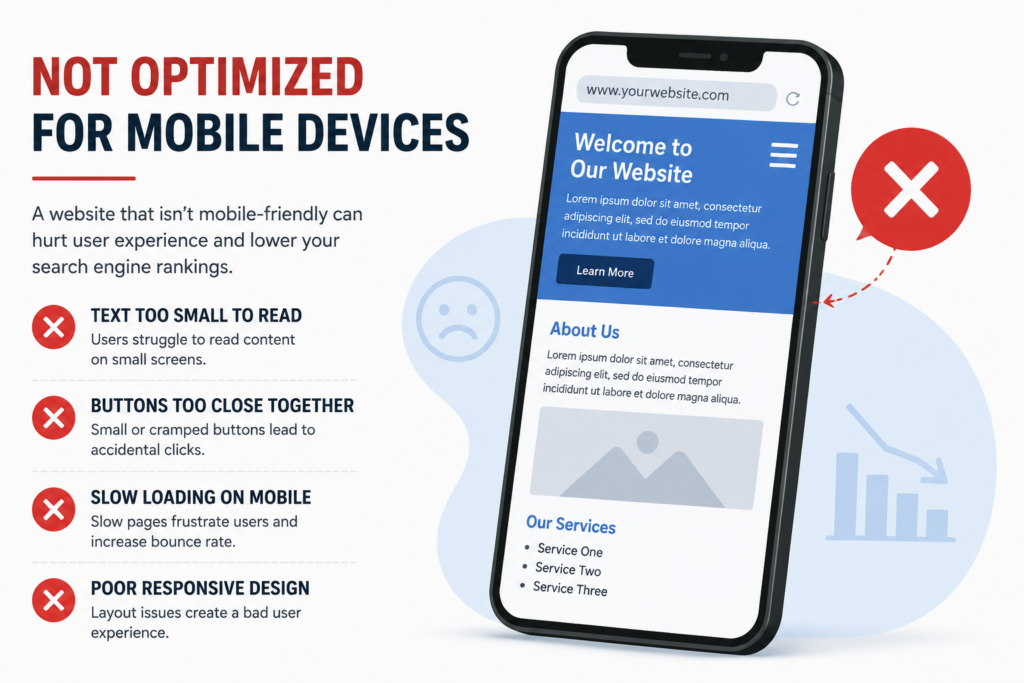
In 2026, the majority of internet users browse websites on smartphones and tablets. Google uses mobile-first indexing, which means it primarily evaluates the mobile version of your website for ranking purposes. If your website is not mobile-friendly, it can negatively affect both user experience and search rankings.
- Common mobile optimization issues include:
- Text that is too small to read.
- Buttons placed too close together.
- Slow loading on mobile devices.
- Poor responsive design.
How to Fix It
Use a responsive website design.
Test your website on different screen sizes.
Optimize images for faster loading.
Make buttons and menus easy to use on mobile devices.
A mobile-friendly website improves user satisfaction and increases your chances of ranking higher on Google.
Slow Website Speed
Website speed is a confirmed Google ranking factor. Visitors expect pages to load within a few seconds. If your website is slow, users are more likely to leave before your content even loads.
Slow websites often suffer from
- Large image files.
- Too many plugins.
- Poor-quality hosting.
- Unoptimized CSS and JavaScript files.
How to Fix It
- Compress and optimize images.
- Enable browser caching.
- Remove unnecessary plugins.
- Use a reliable hosting provider.
- Minify CSS, JavaScript, and HTML files.
Missing Meta Titles and Meta Descriptions
Meta titles and meta descriptions help search engines understand your content while encouraging users to click on your page in search results.
Many websites either leave these fields empty or use duplicate meta tags across multiple pages, reducing their SEO effectiveness
How to Fix It
- Write a unique title for every page.
- Keep titles clear and keyword-focused.
- Create compelling meta descriptions.
- Avoid duplicate metadata.
Weak Internal Linking
Internal links connect one page of your website to another. They help search engines discover your content and guide visitors to related pages.
Without proper internal linking, important pages may receive less visibility, and users may leave your website without exploring additional content.
How to Fix It
- Link to relevant blog posts and pages.
- Use descriptive anchor text.
- Avoid excessive internal links on a single page.
- Update older articles with links to new content.
Ignoring User Experience (UX)
User experience (UX) has become a major ranking factor in 2026. Google rewards websites that are easy to navigate, visually appealing, and provide a smooth browsing experience. If visitors struggle to find information or quickly leave your website, your rankings may suffer.
Common UX issues
- Confusing website navigation.
- Too many pop-ups and intrusive ads.
- Poor readability due to small fonts or cluttered layouts.
- Broken links and error pages.
How to Fix It
- Create a clean and easy-to-use website layout.
- Improve readability with clear headings and spacing.
- Reduce unnecessary pop-ups.
- Regularly check and fix broken links.
Not Updating Old Content
SEO is an ongoing process. Content that performed well a few years ago may become outdated as search trends, technologies, and user expectations change. Regularly updating your content helps maintain its relevance and improves your chances of ranking higher.
How to Fix It
- Refresh outdated information regularly.
- Add new statistics and recent examples.
- Improve content based on current SEO best practices.
- Update keywords where appropriate.
- Check that all links are still working.
Ignoring Technical SEO
Technical SEO ensures that search engines can crawl, index, and understand your website efficiently. Even high-quality content may struggle to rank if technical issues prevent search engines from accessing your pages.
Common technical SEO issues
- Broken links and crawl errors.
- Missing XML sitemaps.
- Poor Core Web Vitals.
- Duplicate content.
- Incorrect robots.txt settings.
How to Fix It
- Submit an XML sitemap to Google Search Console.
- Monitor crawl errors regularly.
- Improve Core Web Vitals.
- Fix broken links and duplicate pages.
- Use HTTPS to secure your website.
Conclusion
SEO in 2026 is about much more than keywords. Search engines prioritize user intent, content quality, website performance, and overall user experience. Avoiding these common SEO mistakes can significantly improve your rankings, increase organic traffic, and help your business grow online.
By focusing on helpful content, technical optimization, mobile usability, and continuous improvements, you can stay ahead of algorithm updates and build a website that performs well in search results for years to come.